


We are continuously working to improve our urban forest throughout Penticton. Find out about our ongoing updates and efforts.
Important Information
Penticton has adopted its first urban forest management plan, also known as the official CommuniTREE Plan, to help manage how the urban canopy develops over the next 20 years.
The plan outlines four different scenarios, including a recommended scenario to show how canopy cover will likely change over the next 20 years in Penticton. Council supported the nine big moves that have been identified to summarize the Action Plan and guide the development for Scenario 4.
Elm seed bugs are not agricultural pests but can be a nuisance in high numbers because they enter homes and businesses. They emit unpleasant odours when crushed and their fecal droppings on structures such as doors and windows can be unsightly. They do not bite people.
Adults are 6.5 – 7 mm long, black and rusty red in colour with black triangle bordered by a rusty coloured rectangle on the back.
You can learn more about elm seed bugs by reading this information sheet from the B.C. Ministry of Agriculture.
McNicoll Renaturalization
In September 2026, the City of Penticton led a tree planting event in collaboration with École Entre-lacs, the Okanagan and Similkameen Invasive Species Society (OASISS), and the Snpink'tn Indian Band. Together, we planted 250 shurbs and 30 trees; defining the landscape by replacing invasive species with native plants. This project was funded in part by Growing Canada's Community Canopies (GCCC), a federal initiative aimed at strengthening communities urban forests.
Thank you to the stakeholders who made this event possible and the more than 70 students and teachers who engaged in our planting event.
Image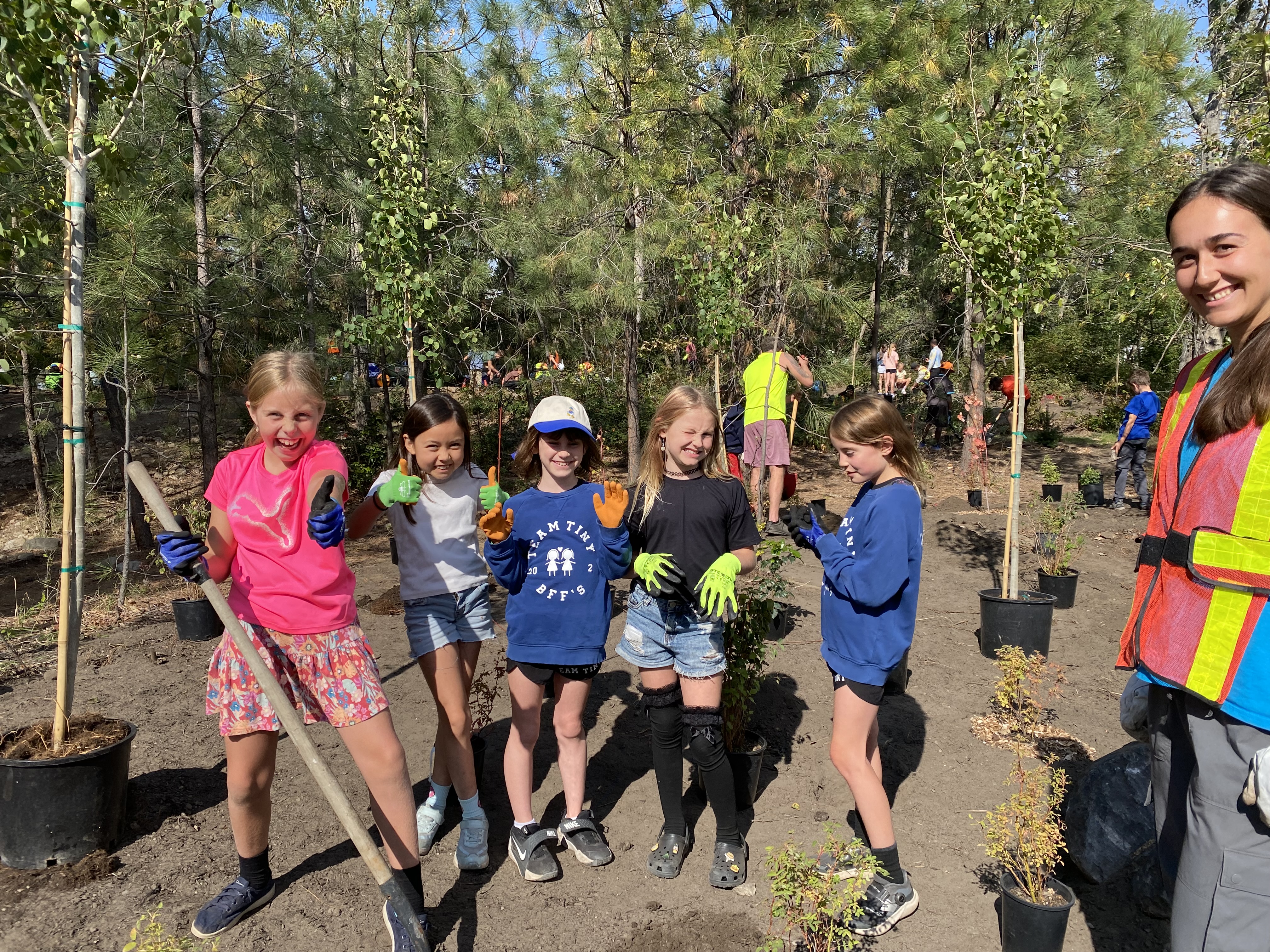
- Trees keep our air supply fresh by absorbing carbon dioxide and producing oxygen.
- In one year, an acre of trees can absorb as much carbon as is produced by a car driven up to 14,000 km.
- Trees lower air temperature by evaporating water in their leaves.
- The average tree in metropolitan area survives only about 8 years!
- A tree does not reach its most productive stage of carbon storage for about 10 years.
- Trees cut down noise pollution by acting as sound barriers.
- Tree roots stabilize the soil and prevent erosion.
- Trees improve water quality by slowing and filtering rainwater as well as protecting aquifers and watersheds.
- Trees provide protection from downward fall of rain, sleet, and hail as well as reduce storm run-off and the possibility of flooding,
- Trees provide food and shelter for wildlife.
- Trees located along streets act as a glare and reflection control.
- The death of one 70-year old tree would return over three tons of carbon to the atmosphere.
To guide climate adaptive tree planting across the city, the City of Penticton has developed an approved Tree Species List. To accompany the list, a guide has been created to walk you through how to select the right tree for the right place.
Trees on the list and within the guide have been deemed suitable for planting in Penticton's current climate while also accounting for projected changes in precipitation, heat exposure, cold snap intensity, and drought.
To report an issue involving a local park, amenity or groundskeeping, please use our Online Form.
Parks Department
Phone: 250-490-2500
Email: parks@penticton.ca